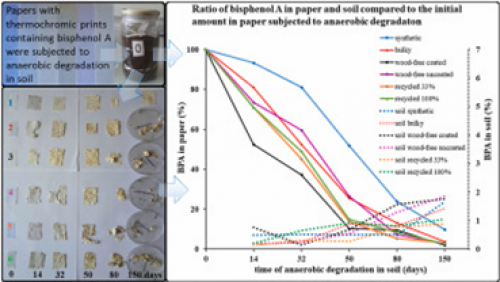
Pseudoestrogene bisphenol A (BPA) can be important ingredient of thermochromic inks, increasingly used materials in thermal printing paper, security printing, advertising, design and as temperature indicators in medicine and food industry. BPA mass fraction in thermochromic inks can be up to several percent. Hence, disposal of items with thermochromic prints pose a risk of environmental pollution. In this work BPA mass fraction was monitored during anaerobic degradation of papers with thermochromic prints in soil in both matrices: papers and soil. Six types of papers with prints of thermochromic ink containing 2% of BPA were analysed over 150 days. After 150 days of anaerobic degradation, only up to 1.86% of BPA contained in paper prints was found in soil, whilst, on average, 4% of initial BPA remained in paper. For soil analysis new HPLC method was developed and validated.




 Pristupačnost