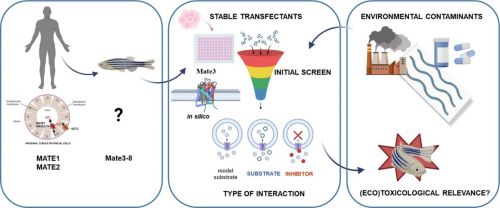
Zebrafish Mate3 is a transmembrane membrane protein which is highly expressed in the kidneys, intestines, testes, and brains of males. Initial interaction studies showed its interaction with xenobiotic compounds, suggesting a role in the efflux of toxic compounds. In the presented paper, interactions of various environmental pollutants with the zebrafish Mate3 protein were studied experimentally and computationally. Experiments consisted of a high-throughput screening assay and kinetics experiments, while computational study consisted of molecular docking based on the 3D structure of zebrafish Mate3 obtained by using AlphaFold2 algorithm. The key interactions between environmental contaminants and zebrafish Mate3 were identified. In addition, the results indicated additional active sites in zebrafish Mate3. Finally, results suggest that some of the identified interactors may be of environmental concern, as their interaction with Mate3 could lead to an impairment of its normal efflux function, making fish more sensitive to harmful substances commonly released into the aquatic environment.




 Pristupačnost